The Church in the Days of the Apostles
That Wonderful Past…
On this page, we would like to begin presenting to you the history of the Church in the manner that we consider suitable for the salvation of your soul.
The Importance of Studying This Period:
Our purpose in studying history is not to examine events and accounts as such. Rather, through knowing these events and accounts, we aim to learn how to live and conduct ourselves, for Christianity is a spirit of life. History, as it takes us back to the past and presents to us the lives of a distinguished group of people, does so “so that we may know the outcome of their conduct and imitate their faith.” If this applies to the history of the Church in general, it applies even more particularly to the Church in the era of the Apostles.
The disciples of the Lord Christ spent a long time with Him. He used to have lengthy private conversations with them, about which the Scriptures have mentioned nothing. He would take them to secluded places, walk with them for hours, and speak to them in the boat or on the shore of the lake. The Holy Bible mentions all these things to us, but it does not tell us what was discussed. Saint John the Beloved is content to say: “And there are also many other things which Jesus did, which if they were written one by one, I suppose that even the world itself could not contain the books that would be written” (John 21:25).
The Book of Acts tells us that the Lord Christ appeared to the disciples for forty days after His Resurrection, speaking to them about the things pertaining to the Kingdom of God (Acts 1:3). But what did He say to them? We do not know!
However, although the words spoken by the Lord Christ to His disciples were not written in the Gospels, some of them have reached us through Tradition and the handing down of the faith, while others have reached us through the Canons and Teachings of the Apostles. They also became manifest in the lives of the Apostles themselves, in their deeds, words, and epistles.
The Apostles, therefore, were a precious treasure. As we study the Church in their era, we wish to learn about the sound and proper conditions under which the Holy Spirit and divine inspiration worked, and in which the teachings of the Lord Christ Himself were preserved. How did that Church conduct itself? This is what we would now like to give an idea about.
The Work of the Holy Spirit
Perhaps the first distinctive characteristic of the Church of the Apostles was the work of the Holy Spirit. The Lord Christ, glory be to Him, commanded them not to depart from Jerusalem until the Holy Spirit came upon them. He then continued, saying: “But you shall receive power when the Holy Spirit has come upon you; and you shall be witnesses to Me in Jerusalem, and in all Judea and Samaria, and to the end of the earth” (Acts 1:4, 8). They first had to receive power from the Holy Spirit, and only then could they bear witness to Christ.
On the Day of Pentecost, “Then there appeared to them divided tongues, as of fire, and one sat upon each of them. And they were all filled with the Holy Spirit and began to speak with other tongues, as the Spirit gave them utterance” (Acts 2:3–4). Thus, Peter was able to deliver a sermon before a crowd of hostile mockers, with the result that “those who gladly received his word were baptized; and that day about three thousand souls were added to them” (Acts 2:37, 41).
It was an ordinary sermon, one that a preacher might deliver today without saving a single soul. But when Peter, filled with the Holy Spirit, delivered it before his enemies, the Scriptures say: “Now when they heard this, they were cut to the heart, and said to Peter and the rest of the Apostles, ‘Men and brethren, what shall we do?'” (Acts 2:37, 41).
From that time onward, the Spirit became everything in their Church. He was the One who called them to ministry, taught them, gave them power, spoke through their tongues, moved them from one place to another, performed miracles through them, and guided their council. Being filled with the Holy Spirit was also an essential and fundamental condition for ministry.
1. The Holy Spirit Called Them to Ministry:
This is perhaps made very clear in the following statement: “As they ministered to the Lord and fasted, the Holy Spirit said, ‘Now separate to Me Barnabas and Saul for the work to which I have called them'” (Acts 13:2).
Since the work is God’s work, it is therefore God’s right to choose for Himself the people who serve Him.
2. He Taught Them and Spoke Through Their Tongues:
The Lord Christ had promised them this, saying: “However, when He, the Spirit of truth, has come, He will guide you into all truth; for He will not speak on His own authority, but whatever He hears He will speak; and He will tell you things to come” (John 16:13).
Thus, the Apostles would first be filled with the Spirit of God, and then they would speak, so that their words would be from God and not from themselves.
After the healing of the lame man, Peter and John were taken before the council. “And when they had set them in the midst, they asked, ‘By what power or by what name have you done this?’ Then Peter, filled with the Holy Spirit, said to them… ‘Let it be known to you all, and to all the people of Israel, that by the name of Jesus Christ of Nazareth, whom you crucified, whom God raised from the dead, by Him this man stands here before you whole'” (Acts 4:7–11).
It would not have been possible for Peter to speak with such boldness had he not first been filled with the Spirit of God.
Then here is Paul, the educated man, explaining to us the effectiveness of the Spirit in speaking. In his Epistle to the Corinthians, he says: “And my speech and my preaching were not with persuasive words of human wisdom, but in demonstration of the Spirit and of power, that your faith should not be in the wisdom of men but in the power of God… For the Spirit searches all things, yes, the deep things of God.” He continues, saying: “These things we also speak, not in words which man’s wisdom teaches but which the Holy Spirit teaches, comparing spiritual things with spiritual” (1 Corinthians 2:4, 5, 10, 13).
3. The Spirit Moved Them from One Place to Another:
Let us consider how the Ethiopian eunuch, the minister of Candace, queen of the Ethiopians, who was in charge of all her treasury, came to believe. He was sitting in his chariot reading the prophet Isaiah. And what happened next? “Then the Spirit said to Philip, ‘Go near and overtake this chariot'” (Acts 8:29).
Philip immediately went and spoke to the Ethiopian minister, preached the Gospel to him, and baptized him. Thus, the name of Christ reached Ethiopia.
Then, how did Cornelius, the centurion, come to believe? A vision appeared to Peter. “While Peter thought about the vision, the Spirit said to him, ‘Behold, three men are seeking you. Arise therefore, go down and go with them, doubting nothing; for I have sent them'” (Acts 10:19–20, 44, 48).
Thus, Peter went and preached to the first Gentile. While he was speaking the word of the Lord, the Holy Spirit fell upon all those who heard the word, and Peter permitted them to be baptized.
And what shall we say about the journeys of Paul and Silas, who “were sent out by the Holy Spirit” (Acts 13:4)? The Scriptures say: “Now when they had gone through Phrygia and the region of Galatia, they were forbidden by the Holy Spirit to preach the word in Asia. After they had come to Mysia, they tried to go into Bithynia, but the Spirit did not permit them… And a vision appeared to Paul in the night. A man of Macedonia stood and pleaded with him, saying, ‘Come over to Macedonia and help us.’ Now after he had seen the vision, immediately we sought to go to Macedonia, concluding that the Lord had called us to preach the Gospel to them. Therefore, setting sail from Troas…” (Acts 16:6–10).
The children of God do not move about in His vineyard of their own accord. Rather, the Holy Spirit moves them from one place to another, preventing them from speaking here and commanding them to preach there, according to His will.
4. The Spirit Performed Miracles Through Them:
Ananias and Sapphira attempted to lie to Peter, but he said to Ananias: “Why has Satan filled your heart to lie to the Holy Spirit?” And he said to Sapphira: “How is it that you have agreed together to test the Spirit of the Lord?”
In reality, they were testing Him, but Peter himself was not acting independently; rather, it was the Spirit of God dwelling within him. Thus, Ananias fell dead, and so did his wife. “So great fear came upon all the Church and upon all who heard these things” (Acts 5:1–11).
Then here is Paul, together with Silas, in Paphos. Elymas the sorcerer opposed them, seeking to turn the proconsul away from the faith. “Then Saul, who also is called Paul, filled with the Holy Spirit, looked intently at him and said… ‘And now, indeed, the hand of the Lord is upon you, and you shall be blind, not seeing the sun for a time…'” (Acts 13:9–12).
The man became blind, and the proconsul believed. The Holy Spirit grants the children of God extraordinary power.
5. The Holy Spirit Guided Their Council:
The Apostles gathered in the Council of Jerusalem and considered the matter of the faith of the Gentiles. They then issued a decision concerning it and sent their decision in a letter to the brethren in Antioch, Syria, and Cilicia, saying: “It seemed good to the Holy Spirit, and to us…” (Acts 15:28).
Thus, we see that they did not issue a decision of their own accord. Rather, the Holy Spirit made the decision, and they conveyed to the people what He had determined.
6. Being Filled with the Holy Spirit Was an Essential and Fundamental Condition for Ministry:
When the seven deacons were chosen, the twelve said to the multitude of the disciples: “Therefore, brethren, seek out from among you seven men of good reputation, full of the Holy Spirit and wisdom, whom we may appoint over this business…. And they chose Stephen, a man full of faith and the Holy Spirit…” (Acts 6:3, 5).
This condition was an important factor in the success of the ministry. The Synagogue of the Libertines, Cyrenians, and Alexandrians stood against Stephen, but “they were not able to resist the wisdom and the Spirit by which he spoke…” (Acts 6:10).
This deacon attained such a degree of holiness that they took him to stone him for the sake of Christ. “But he, being full of the Holy Spirit, gazed into heaven and saw the glory of God, and Jesus standing at the right hand of God…” (Acts 7:55).
And while they were stoning him, “he knelt down and cried out with a loud voice, ‘Lord, do not charge them with this sin.’ And when he had said this, he fell asleep” (Acts 7:60).
This is what concerns Stephen. As for Barnabas, who was also sent to Antioch, it was said of him that he was “a good man, full of the Holy Spirit and of faith” (Acts 11:24). Therefore, it was also said: “And a great many people were added to the Lord.”
And furthermore, this is something of the work of the Holy Spirit in the Church in the days of the Apostles. This is how the Spirit of God must work in the Church in every generation, so that it may be called the Church of God.
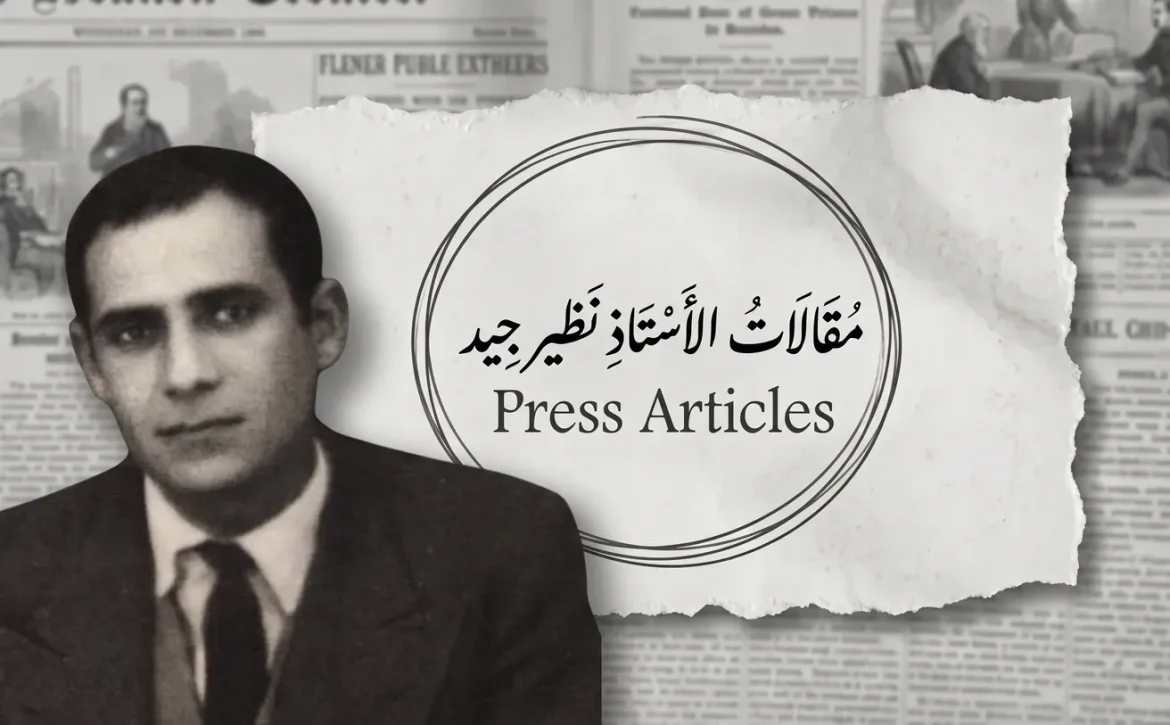
Nazir Gayed
For better translation support, please contact the center.