10Feb2026
  • Sanan Pasha Street – El Zeitoun – Cairo
  • [email protected]
TwitterFacebook-fYoutubeSpotifySoundcloud
logotype
  • Home
  • Index
    • Video Index
    • Audio Index
      • Other Miscellaneous Topics
    • Articles Index
    • Books Index
  • Encyclopedias
  • Video Lectures
  • Audio Lectures
  • E-Books
  • Photo albums
  • العربية
Contact Us
logotype
  • Home
  • Index
    • Video Index
    • Audio Index
      • Other Miscellaneous Topics
    • Articles Index
    • Books Index
  • Encyclopedias
  • Video Lectures
  • Audio Lectures
  • E-Books
  • Photo albums
  • العربية
Contact Us
  • Home
  • Index
    • Video Index
    • Audio Index
      • Other Miscellaneous Topics
    • Articles Index
    • Books Index
  • Encyclopedias
  • Video Lectures
  • Audio Lectures
  • E-Books
  • Photo albums
  • العربية
logotype
logotype
  • Home
  • Index
    • Video Index
    • Audio Index
      • Other Miscellaneous Topics
    • Articles Index
    • Books Index
  • Encyclopedias
  • Video Lectures
  • Audio Lectures
  • E-Books
  • Photo albums
  • العربية
The Nativity of the Lord Jesus Christ as a Divider Between Two Distinct Eras
Home All Categories Encyclopedias Encyclopedia of Feasts and Occasions The Nativity of the Lord Jesus Christ as a Divider Between Two Distinct Eras
Encyclopedia of Feasts and Occasions
6 January 20070 Comments

The Nativity of the Lord Jesus Christ as a Divider Between Two Distinct Eras

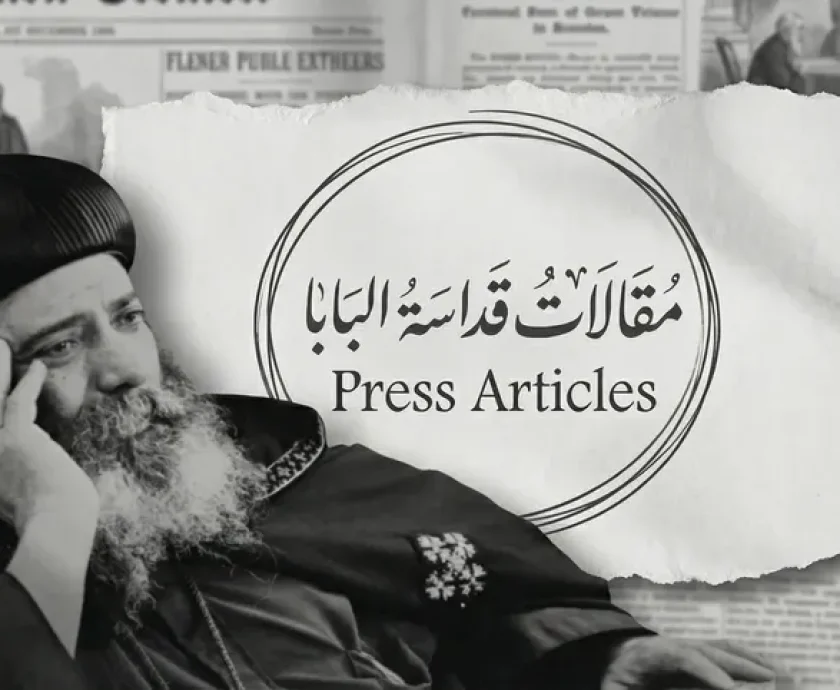
مقالات قداسة البابا
تحميل
📄 تحميل PDF 📝 تحميل Word 📚 تحميل ePub

The Nativity of the Lord Jesus Christ as a Divider Between Two Distinct Eras¹

My beloved sons and brothers…
I congratulate you on the beginning of a new year and on the new Feast of the Nativity, wishing for all of you, and for all the people of Egypt whom the Lord has blessed, happy peaceful days filled with the work of His grace.
With the Nativity of the Lord Jesus Christ, the world began a new era, completely different from the eras that preceded it. And this glorious Nativity became a separator between two distinct times: before the Nativity and after the Nativity.
So what is this newness that gave the world a new image it never had before? Or what is this renewal that Christianity presented, so that it was said in the Gospel: “The old things have passed away; behold, all things have become new”?
The Lord Jesus Christ presented a new concept of life, and new expressions that had not been used before, and deep spiritual meanings for all perceptions, so that His listeners were astonished at His words and cried out saying, “Never has a man spoken like this”… The Lord Jesus came spreading love among people, and between people and God. He presents God to people as a loving Father, treating them not as slaves but as children, and they pray to Him saying: “Our Father who art in the heavens.” And in the care for His love, people do His commandments not out of fear of His punishment, but out of love for goodness. And in this Christianity said:
“God is love. He who abides in love abides in God, and God in him.”
“There is no fear in love; but perfect love casts out fear.”
Thus the Lord Jesus said that all the commandments are concentrated in one, which is love: You shall love the Lord your God from all your heart, from all your mind, and from all your strength; and you shall love your neighbor as yourself. On this hang all the Law and the Prophets.
And Christ introduced a new teaching in love, which is loving enemies and those who wrong us. He said: “Love your enemies, bless those who curse you, do good to those who hate you, and pray for those who spitefully use you and persecute you.” And Christianity sees in this that repaying evil with evil, and aggression with aggression, means that evil has won. While the teaching of Scripture is: “Do not be overcome by evil, but overcome evil with good,” “If your enemy hungers, feed him; if he thirsts, give him drink.” Love must triumph, because “Love never fails,” “Many waters cannot quench love.”
The phrase “God is love” is a new phrase to the world, which had known only a mighty fearful God whose power people dreaded and whom they appeased with sacrifices and various rituals… And the phrase “Love of enemies” is a new phrase in human dealings; the world was astonished to hear it from the mouth of Christ…
And in love, Christ also brought the good tidings of peace…
Peace among people, peace between man and God, and peace in the depths of the soul from within.
A peace from God surpassing all understanding. And when Christ was born, the angels sang: “And on earth peace,” because He came to establish reconciliation between heaven and earth, between God and humankind, after sin had set up a barrier between man and God…
And He desired that this reconciliation always continue in human relationships. He said: “If you bring your gift to the altar, and there remember that your brother has something against you, leave your gift before the altar, and go; first be reconciled to your brother.”
For reconciliation is better than offering sacrifices.
And Scripture says: “I desire mercy and not sacrifice.” Likewise Christ said: “Agree with your adversary quickly while you are on the way with him.” And He also said: “If anyone wants to sue you and take away your tunic, let him have your cloak also”…
And the Lord Jesus desired that peace spread among people. He said to His disciples: “Whatever city you enter, say: Peace to this house,” “A new commandment I give to you, that you love one another as I have loved you,” “By this all will know that you are My disciples, if you have love for one another”… And for the sake of peace, Christianity called people to be “preferring one another in honor”…
For love can be proven through humility, self-denial, and bearing with others.
For this reason the Lord Jesus said: “Whoever desires to come after Me, let him deny himself, take up his cross, and follow Me.”
The phrase “self-denial” is a new phrase that Christianity presented to the world. Before that, the (self) was an idol worshiped by its owner, who desired to grow and be glorified…
And Christ set new standards for strength. Strength is not an outward appearance of domination and victory over others; rather, strength is something internal in the depths of the soul, to triumph over oneself. He who conquers himself is better than he who conquers a city. And in Christianity, strength is not that we overpower others, but that we win them and bear with them. He who bears with others is the strong one… but the aggressor is the weak one. Thus Scripture says: “We then who are strong ought to bear with the weaknesses of the weak”… The aggressor is weak because he is overcome by his sin, overcome by violence, and by his lack of love for others, no matter how strong he appears outwardly. But he who bears is strong: strong in his self-control, strong in not avenging himself.
Time fails me, my brothers, if I speak to you of all the new spiritual principles the world came to know through the Nativity of Christ… But it is enough to say that the era after the Nativity was entirely new in its concepts. Even the sublime laws of God which He gave in the Old Testament were not understood by the people, for a veil was over their eyes and hearts and minds, until Christ revealed to them the beauty and loftiness in the Law… To Him be glory now and forever. Amen.


  1. An article by His Holiness Pope Shenouda III published in Akhbar El-Youm newspaper on 6-1-2007.

For better translation support, please contact the center.

Al-Akhbar Newspaper The Nativity of the Lord Jesus Christ as a Divider Between Two Distinct Eras
0 Likes
ترجمة المقالات said:  A Call to Repentance at the Beginning of the Year

ترجمة المقالات said: A Call to Repentance at the Beginning of the Year

31 December 2006

Christ Came for All He lifts up everyone’s spirits

7 January 2007
Christ Came for All He lifts up everyone’s spirits

منشورات ذات صلة

popeshenoda podcast
Encyclopedia of Feasts and Occasions
27 September 2000

The Cross

By Helana Ghatas
popeshenoda podcast
Encyclopedia of Feasts and Occasions
11 June 1997

Holy Spirit

By manal Fahim

Leave a Reply Cancel reply

Your email address will not be published. Required fields are marked *

Archive by Date
الاقسام
  • All Categories(2,762)
    • Digital Library(2)
      • E-books(1)
      • Video(1)
    • Encyclopedias(2,660)
      • Encyclopedia of Ascetic Theology(12)
        • Life of Stillness(3)
        • Monasticism(5)
      • Encyclopedia of Barthology(28)
      • Encyclopedia of Canon Law (Legislative Theology)(93)
        • Canons of the Ecumenical Councils(4)
        • Canons of the Fathers (Apostles and Patriarchs)(7)
        • Church Penalties(15)
        • Ibn al-‘Assal’s Canonical Collection(6)
        • Personal Status(32)
      • Encyclopedia of Church History(120)
        • Historical Verification(2)
        • Saint Mark and the Church of Alexandria(12)
          • Christianity in Egypt(1)
          • History of the Coptic Church and Its Martyrs(2)
          • Life of Saint Mark the Apostle(2)
          • The Church of Alexandria and Its Patriarchs(7)
        • The Church after the Schism – The Middle Ages(5)
          • Famous Christians in the Islamic Eras(1)
          • The Armenians(1)
          • The Church after Chalcedon(1)
        • The Church before the Schism(30)
          • Famous Fathers in the Early Centuries(5)
          • History of Heresies and Schisms in the Early Centuries(5)
          • Monasticism(8)
          • The Fourth Century and Its Importance(7)
        • The Church in the Modern and Contemporary Era(1)
          • The Church in the Diaspora(1)
        • The Early Church(16)
          • Our Apostolic Fathers(8)
          • The Beginning of the Christian Church(2)
      • Encyclopedia of Comparative Theology(324)
        • Differences with the Catholics(23)
        • Differences with the Protestants(42)
        • Doctrinal Issues(8)
        • Jehovah’s Witnesses(12)
        • Modern Heresies(42)
        • Pelagianism and Original Sin(2)
        • Seventh-day Adventists(11)
      • Encyclopedia of Dogmatic Theology(150)
        • Redemption(5)
        • Salvation(1)
        • The Angels(6)
        • The Holy Trinity(12)
        • The Incarnation(5)
        • The Theology of the Holy Spirit(4)
        • The Virgin Mary, Mother of God(18)
      • Encyclopedia of Dogmatic Theology(103)
        • Atheism(4)
        • Attributes of God(80)
      • Encyclopedia of Eschatology(34)
      • Encyclopedia of Feasts and Occasions(136)
        • Beginning of the New Year(4)
        • Feast of the Epiphany(8)
        • Feast of the Nativity(13)
        • Feast of the Resurrection(6)
      • Encyclopedia of Liturgical Theology(48)
        • Church Occasions(1)
        • Liturgies(5)
        • The Altar(2)
        • The Church(24)
        • The Sacraments(1)
      • Encyclopedia of Moral Theology(127)
        • Christian Concepts(10)
        • Christian Conduct(7)
        • The Conscience and the Influencing Factors(7)
        • The Human(7)
        • Virtues (Moral Theology)(3)
      • Encyclopedia of Pastoral Theology(568)
        • Church Organizations(12)
        • Concepts(87)
        • God’s Providence(31)
        • Priestly Service(167)
        • Some Categories of Pastoral Care(119)
        • Some Fields of Pastoral Care(21)
      • Encyclopedia of Spiritual Theology(373)
        • Life Experiences(2)
        • Milestones of the Spiritual Journey(11)
        • Questions and Answers(2)
        • Spiritual Theology – Virtues(35)
          • Faith(1)
          • Love(5)
          • Meekness and Humility(4)
        • Spiritual Warfare(18)
          • The Self(1)
          • Wars of Thought(1)
        • The Spiritual Man(10)
      • Encyclopedia of the Holy Bible(259)
        • New Testament(67)
          • Commentary on the New Testament(47)
          • Persons of the New Testament(5)
          • Spiritual Topics – New Testament(9)
        • Old Testament(113)
          • Commentary on the Old Testament(35)
          • Persons of the Old Testament(61)
          • Spiritual Topics – Old Testament(1)
      • Encyclopedia of the Saints’ Lives(97)
        • Feasts of the Saints(1)
        • Lives of the Anchorite Fathers(11)
        • Lives of the Martyrs and Confessors(4)
        • Saints of Virginity and Monasticism(4)
      • Others, Miscellaneous and Various Topics(98)
      • Poems, Hymns, and Songs(96)
    • Questions(29)
Related Topics
  • The Feast of Nayrouz and Martyrdom
    The Feast of Nayrouz and Martyrdom
    8 September 2010
  • Nowruz and Martyrdom Day
    8 September 2010
  • The Transfiguration of Human Nature in the Resurrection¹
    The Transfiguration of Human Nature in the Resurrection¹
    4 April 2010
Tags
Al-Ahram Newspaper Al Keraza Magazine Asceticism Audio Section Care Church Creation Divinity Education Eternity Faith Forgiveness giving Grace Holiness Holy Spirit Hope Humility Incarnation Knowledge Love Marriage Meditations on the Song of Songs Mercy Monasticism Obedience Peace Prayer Preaching Priesthood Purity Redemption Repentance Responsibility Resurrection Salvation Service spirituality Steadfastness Teaching Unity Video Section Virtue Watani Newspaper Wisdom

Quick Links

Encyclopedias Photo albums E-Books Graphic Designs Contact us

Encyclopedias

Comparative Theology Spiritual Theology Liturgical Theology Pastoral Theology Theoretical Theology

Contact the Center

Sanan Pasha Street – El Zeitoun – Cairo

[email protected]

www.popeshenouda.org.eg

TwitterFacebook-fYoutubeSpotifySpotify
logotype

© All rights reserved to Foundation of His Holiness Pope Shenouda III for Heritage Preservation

Privacy Policy

Terms and Conditions