

Father Philotheos Ibrahim
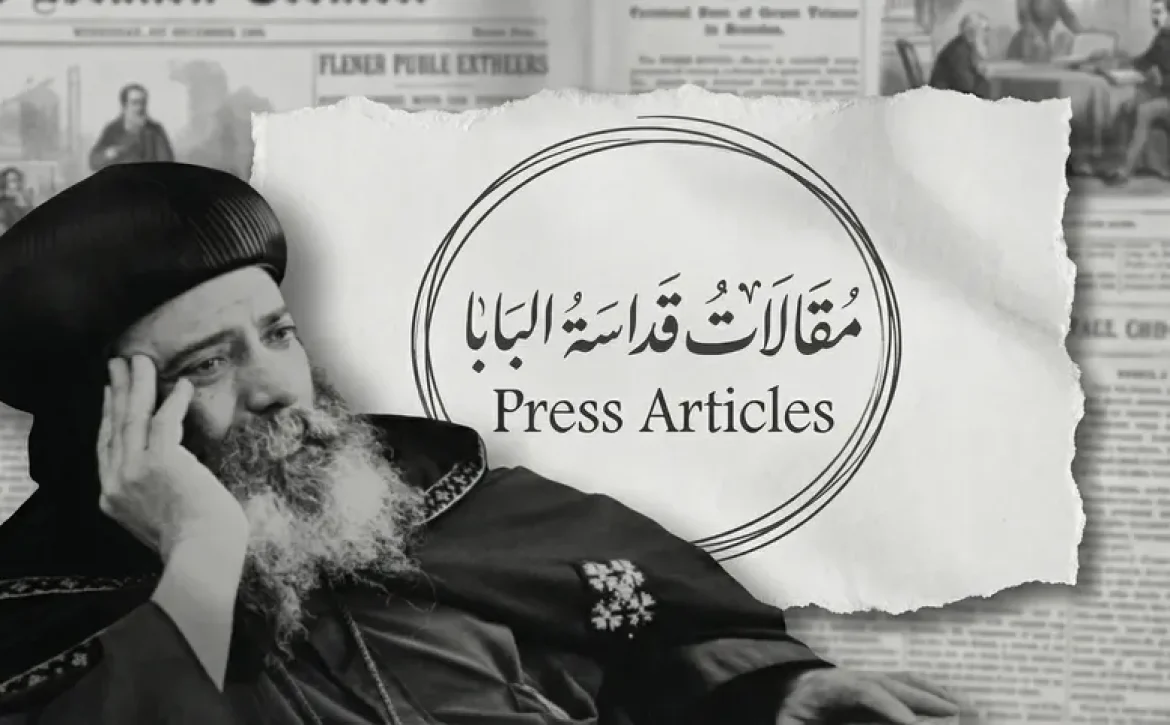
Father Philotheos Ibrahim¹
In the previous issue we spoke with you, dear reader, about the greatest of our preachers in this generation, Professor “Habib Girgis.” In this issue we speak about Professor “Habib Girgis,” about the first preacher known to our modern era, and the first professor of religion at the Seminary, namely:
Father Philotheos Ibrahim
(Born in 1837, reposed on March 10, 1904).
He lived in an era in which preaching was limited to written sermons that were read to people on occasions. Indeed, when he stood on the pulpit of the church to preach, his opponents rose against him—as though he were an innovator—and obtained an order from his metropolitan suspending him from preaching in his town (Tanta)… At the same time, denominations and foreign missions were expanding and growing throughout the Egyptian country… and the entire burden fell upon this genius.
He was born in Tanta and was raised under the care of a kuttab teacher, where he learned the principles of reading and writing, studied the Coptic language and hymns, and trained in diaconal service. Then he completed his studies at the school of Pope Cyril IV, where he studied the Coptic language under its great professor, the teacher Aryan Muftah. He excelled to the point that he later taught this language at the Harat al-Saqqayin School and at the Great Coptic School, authored books for it, and also learned the Italian language. His eloquence and skill in Arabic literature became evident.
He devoted himself to the Patriarchate Library, studying its books and manuscripts in theology, doctrine, and interpretation. When his brilliance became evident, Anba Yuhanna, Metropolitan of Menoufia and Tanta, summoned him under the pretext that he had a book he wanted corrected. When he came to him, and while he was occupied with that book, he laid upon him the hand of priesthood, then celebrated his ordination (in June 1862), when he was twenty-five years old, and then promoted him to the rank of hegumen in 1865.
Hegumen Philotheos Ibrahim excelled in preaching until his fame spread far and wide. His activity was not limited to Tanta alone, but extended from Jerusalem to the far reaches of Sudan. When his metropolitan suspended him from preaching in Tanta, it was not possible for this decision to be practically implemented because of the need for preaching, so the metropolitan retracted his decision. Hegumen Philotheos authored a book on preaching and its importance.
In 1866 he went to Jerusalem, where he delivered a series of sermons in defense of the doctrine of the Church, which were met with great success. His Grace Anba Basilios in Jerusalem honored him with celebrations rarely offered by a metropolitan to a priest, and the Antiochian Patriarch honored him as well and celebrated a liturgy according to the Coptic rite in the Syriac Orthodox Church in Damascus. In 1867 Pope Demetrius took him with him to Upper Egypt, where he preached at religious gatherings. He was received with great welcome, to the extent that on one occasion he spoke continuously for three hours, proving the soundness of the Orthodox doctrine. People crowded to hear the word of God from his mouth. Thus, in 1883 he was summoned to Assiut to preach there, where he spent forty-five days in daytime and nighttime religious celebrations, in which people could not find a place, even sitting on the church windows… and no one ever tired of hearing him no matter how long he spoke… and so it was when he traveled to Aswan.
In 1870 he was assigned to assume the supervision of the Coptic schools, traveling to them from Tanta. He cared for them and spread the teaching of the Christian faith within them. He authored books in this regard, the most important of which was “Enlightening Beginners in Teaching Religion.” However, he could not continue and resigned after two years.
After the ordination of Pope Cyril V, the opinion settled on transferring him to Cairo for the general good of the Church and to care for religious education in general. He apologized for this matter, and the people of Tanta clung to him strongly, but this did not avail, so the papal decree was issued on January 13, 1875, electing him head of the Great St. Mark’s Cathedral and director of a seminary to be established at the Patriarchate. He undertook his work with zeal, although that seminary did not last long, because the majority of its students were monks who soon returned to their monasteries.
When the seminary was reopened in 1893, they found no one but him to teach religion there, so he did so for a short time, as his health did not help him. While he was delivering his lessons, he fainted and was carried to his home, where he remained bedridden. Students of his knowledge—such as Deacon Habib Girgis—would visit him there to seek his guidance in the sciences of religion.
Hegumen Ibrahim spent about forty years as a preacher, teacher, and administrator of the affairs of the Church. He had a great influence on the social body and resolved many problems due to his wide knowledge of laws and regulations. He carried out major works in the reform movement.
He would deputize for His Beatitude the Patriarch in meeting rulers, who loved and honored him for his eloquence, fine style, and breadth of knowledge. He received decorations from Khedive Tawfiq and Khedive Abbas Hilmi II.
The emperors of Ethiopia honored him greatly. In 1882 Negus Yohannes wrote to him a letter full of reverence, opening it with the words: “To the venerable father, upright in opinion and conscience, treasure of wisdom, broad of mind and long-suffering, shepherd and guardian of the trust of Alexandria…” and requested his prayers. Another letter reached him in 1899 from “Negus Menelik,” requesting his books to translate them into Ethiopic, and presenting him with the Order of the Star.
Among the finest letters that reached him was a letter written to him by Saint Anba Abraam, Bishop of Fayoum, which he headed with the phrase: “To the holy, beloved, venerable brother, the servant of God in piety, my dear Hegumen Philotheos…” In that letter he congratulated him on his recovery and said: “All of us with you are lifting up the hands of supplication for your long continuance as a shining lamp in the Church of God which He purchased with His blood…” He concluded the letter by saying: “And let your pure conscience know… that you are always a radiant image before our eyes; we remember you with all joy, and we rejoice in your beloved remembrance.” Likewise, Father Abd al-Masih al-Mas‘udi wrote about him a letter full of appreciation and praise.
Father Philotheos—besides what we have mentioned—authored valuable works, the most important of which are:
-
“The Fragrance of Perfume in the Refutation of al-Bashir,” in defense of the doctrine of the Coptic Church regarding the nature of Christ, and an article on the same subject published by Gerasimos Massarra.
-
“The Orthodox Argument against the Roman Claim,” to refute what Rome claims regarding primacy.
-
“The Legal Summary in Personal Status.”
-
Other books on the Nativity, the Resurrection, the Divinity of Christ, the Oneness of God, and the explanation of prophecies, and a well-known treatise on: “The Wisdom of the Law in Translating the Prayers of the Church.”
He—may God repose his soul—was a source of inexpressible trust in religious knowledge, and he was also held in esteem by non-Christians and other Christian denominations. It was said of him that he was “the champion of knowledge,” “the leader of preachers and the theological chief of the Church,” “the nightingale of the Coptic Church,” “the pole of the Orthodox clergy and its shining lamp,” and “the orator of the nation, its admonisher, its preacher, and its tongue.” He was zealous for his faith, very strong in his argument, eloquent in style, and vast in knowledge.
He left behind a large library rich with books, the inheritance of which was a matter of dispute, and it finally passed to the husband of his daughter, Professor Girgis Philotheos Awad.
-
An article by His Holiness Pope Shenouda III – in Al-Kiraza Magazine – First Year – Issues Two and Three, January and February 1965.
For better translation support, please contact the center.
