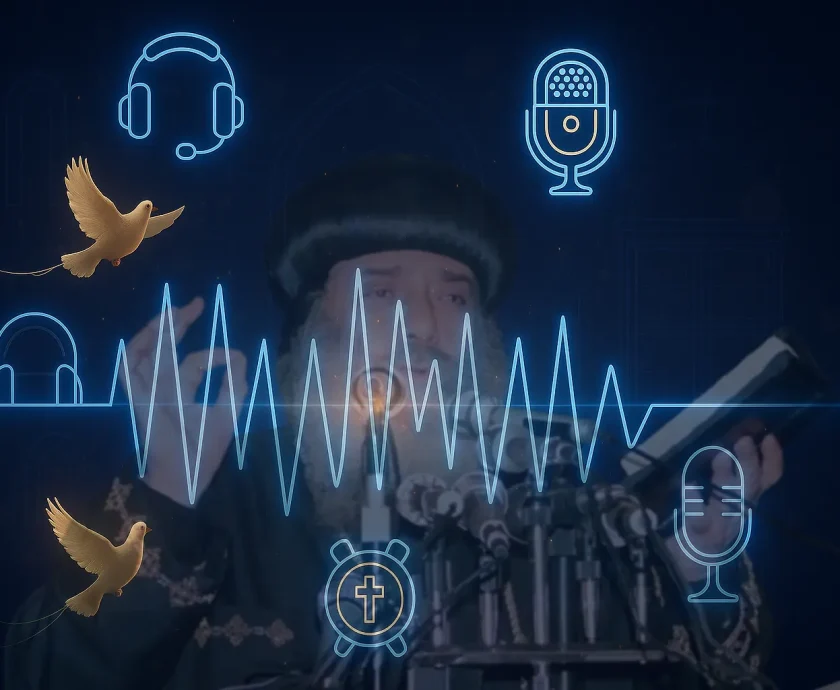
A mother gives endlessly — how can we honor her?

Pope Shenouda III began by thanking and congratulating all mothers on the occasion of Mother’s Day, celebrated in Egypt on March 21st, the day of the spring equinox. He considered this choice a blessed one, as it symbolizes beauty, renewal, and giving.
He then spoke about the instinct of motherhood that God planted in the heart of every woman. By her very nature, a woman desires to be a mother and feels deep sorrow if she cannot bear children, for motherhood is a sacred instinct given by God. The Pope explained that Eve did not receive her name until after she gave birth, because she became “the mother of all living.”
Pope Shenouda clarified that a mother is not only one who gives birth, but one who raises her children well, quoting the early Church Fathers:
“A woman does not become a mother by giving birth, but by raising her children.”
Thus, true motherhood lies in nurturing faith, virtue, and moral values in one’s children.
He described the mother as a symbol of sacrifice and endurance. She gives of her own body during pregnancy—her blood, calcium, and protein—to form the baby, and continues to give through nursing, sleepless nights, and loving care.
Pope Shenouda spoke tenderly about the hardship of raising children: keeping them clean and healthy, feeding them, enduring their crying and disobedience, even staying home from church because of them. He lamented that many fathers fail to appreciate this enormous effort, yet mothers continue with love and self-denial.
He humorously remarked on how children are often identified by their father’s name:
“She’s the one who carried, suffered, gave birth, and raised him—and then they say, ‘He’s so-and-so’s son!’”
The Pope then gave advice for mothers during pregnancy, emphasizing that their physical and emotional wellbeing affects the baby. Husbands, he said, should treat their wives with gentleness, patience, and love, because a child inherits psychological traits from the mother, not only physical ones.
He praised working mothers, who not only endure the pain of childbirth but also the burden of labor to help their families. He reflected that God told Adam, “By the sweat of your brow you shall eat bread,” and told Eve, “In pain you shall bring forth children,” but today, women bear both burdens.
He noted that because of working mothers, daycare centers have become common, yet the natural and emotional bond between mother and child remains irreplaceable.
Then the Pope spoke about the spiritual role of the mother, calling her “the first deaconess in the home.” She carries the baby during baptism, renounces Satan on his behalf, recites the Creed, and later bears responsibility for his spiritual and church upbringing.
He gave several examples of holy mothers:
-
Jochebed, mother of Moses the Prophet, who also bore Aaron and Miriam.
-
The mother of St. Basil the Great, who raised four saints: Basil, Gregory, Peter, and Macrina.
-
In Egypt: St. Dolagy, St. Rebecca, and St. Julitta.
-
And the mother and grandmother of St. Timothy, who passed on their sincere faith.
Pope Shenouda emphasized that the mother is the first school, saying:
“Your child spends one hour a week in Sunday School, and 167 hours with you. You are responsible for his spiritual upbringing.”
He cited the example of St. Monica, mother of St. Augustine, who wept and prayed fervently for her son’s salvation until St. Ambrose said:
“A child of such tears cannot be lost.”
In closing, the Pope also honored:
-
Nuns (as spiritual mothers).
-
Widowed mothers, who make great sacrifices for their children.
📜 Summary Thought:
A mother is the heart of giving, the source of life, the first teacher of faith, and the image of divine love on earth.
She gives without asking, endures without complaining, and loves without measure.
As Pope Shenouda beautifully said:
“A mother doesn’t need a special day to be honored — she deserves to be honored every day.”
“for better translation support, please contact the center”